Summary
Current Situation:
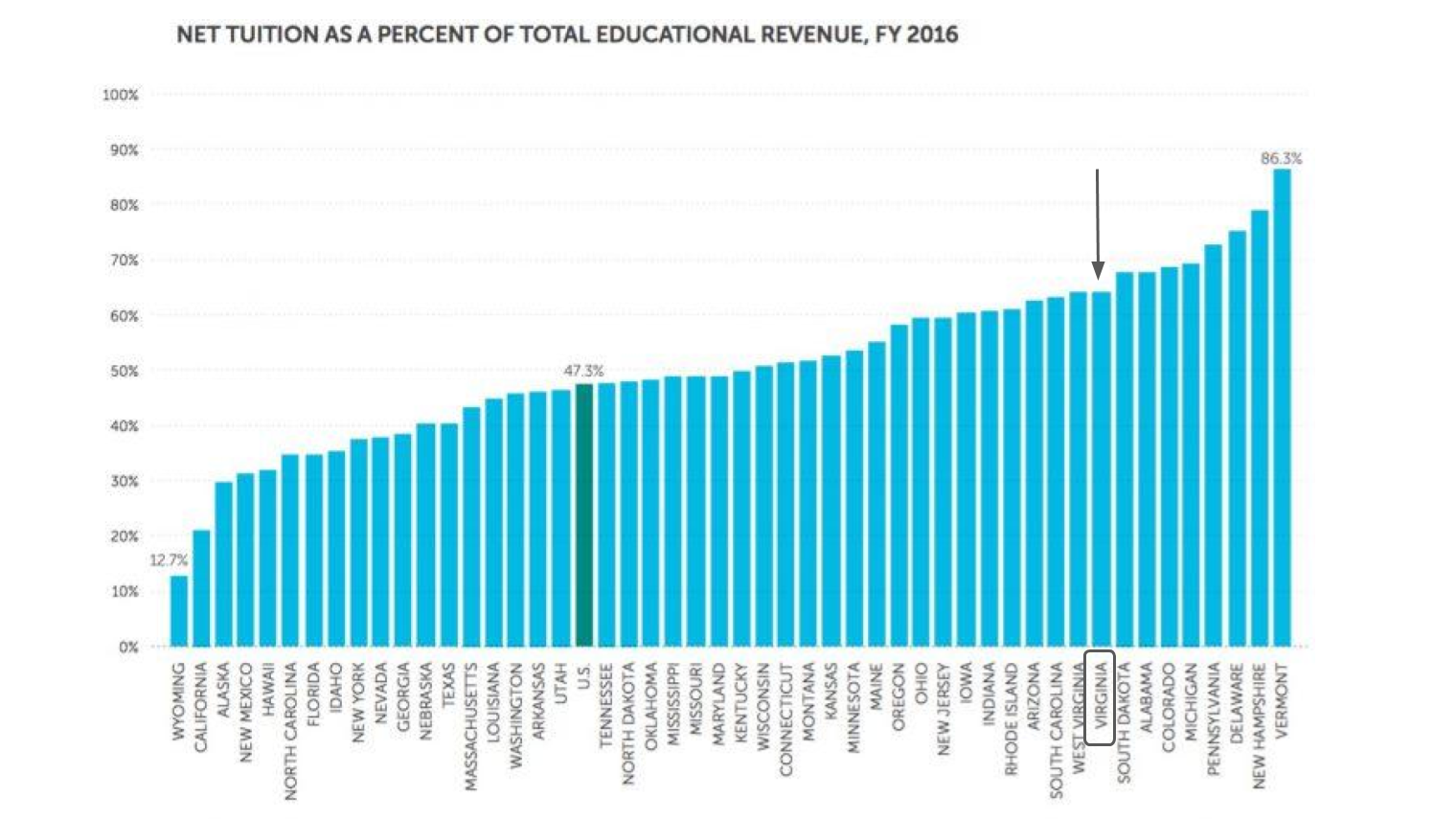
The data show that Virginia has above-average in-state tuition and below-average per-student tax appropriations. Tuition and fees at Virginia public research, four year, and two year institutions in 2017-2018 are among the highest in the US.
When viewing this post, select the Feature Image to view the chart’s details.
Challenge:
How to make higher education more affordable for Virginia residents particularly lower income students while expanding educational opportunities and controlling costs?
General Assembly
State Senate
Senate Education and Health Committee
A Republican senator wants students to approve tuition increases before governing boards do
Mechelle Hankerson, Virginia Mercury, December 24, 2019
Stuart wants to make other cost increases at public colleges more understandable. He filed separate legislation that requires university governing boards to provide written notice of why they want to increase a president’s compensation and where the funding for the raise would come from. The boards must allow public comment on the change and the increase has to be voted on in an open meeting.
According to the Richmond Times-Dispatch’s database of state employee salaries, seven of the 10 highest paid state employees were university presidents this past year:
- Michael Rao at VCU made $1 million
- University of Virginia President James Ryan made $962,875
- J.H. Binford Peay at Virginia Military Institute made $837,267
- Virginia Tech President Timothy Sands made $775,000
- Paul Trible at Christopher Newport made $771,287
- Angel Cabrera, who left his position as president of George Mason this summer, made $763,226
- John Broderick at Old Dominion made $638,217
Those amounts include housing, cell phone allowances, transportation, bonuses and other items that made up the presidents’ total compensation.
House of Delegates
Virginia21 2019 General Assembly Candidate Survey
Higher Education Attainment – Please share your platform on higher education funding and college affordability. Do you support increasing state financing of student aid in the biennial budget? Do you support increasing the amount awarded to students enrolled in private colleges and universities through the Tuition Assistance Grant? How can Virginia ensure equity in access and attainment for all students, particularly those from underserved groups?
Wendy Gooditis – VA House District 10 (D)
I support funding for our public colleges and universities, as I understand that education is a critical area of investment for our economic future. I also support Tuition Assistance Grants for students attending institutions that demonstrate financial responsibility and provide quality education. I believe financial aid assistance, especially at our public colleges and universities, should be increased to provide greater access to underserved communities.
Student Debt – Student loan debt has surpassed auto loans and credit cards to become the second highest form of consumer debt. The average Virginia college graduate now owes over $30,000 in student debt. How should Virginia address the mounting burden of student debt and its economic impact? Do you support strengthening oversight of student loan servicers?
Federal Funding Options
Source: Vox
Democrats’ ongoing argument about free college, explained
By Matthew Yglesias
Vox – June 24, 2019
It’s a debate that cleaves two philosophically distinct approaches to politics: one a mentality of hoarding scarce resources for the most efficient uses, and the other a broad, aspirational vision of public luxury in which there’s little need to quibble about exactly who gets what.
Yet the federal government is a secondary actor in higher education. State governments allowed higher education cost structures to rise even while pulling back on funding, pushing more costs onto students. It’s ultimately state governments that will need to decide whether they’re willing to spend more on higher education, cut costs, or both. The candidates arguing about this are running for president, not governor, and when you look under the hoods of their plans, there may be less to the contrast than the broad philosophical discussion would suggest.
Senator Warner
Senator Mark Warner
“Warner remains committed to ensuring that every Virginian has access to the quality education and training needed to succeed in our global economy without the burden of crippling student debt. Having paid for his own undergraduate education with student loans, Senator Warner knows first-hand the financial challenges facing those who seek higher education. Senator Warner will continue to fight for commonsense solutions to make college more affordable and to help those who are already struggling with student debt. Senator Warner believes that if left unaddressed, student debt will be the next financial crisis facing our country. Senator Warner also knows that college isn’t the only path to success. He believes that we must increase our focus on industry certifications and lifelong learning and retraining in order to create more opportunities for good paying jobs for Virginians.”
Sen. Mark Warner meets with Mason students to talk about college affordability
By John Hollis
September 13, 2019
His father paid for his first semester of college, U.S. Sen. Mark Warner said Friday, but that after that, he was on his own and took out student loans to pay for his education.
Speaking in The Hub Ballroom to an estimated 200 Mason students, faculty and staff, the two-term Virginia Democrat and former Virginia governor said he wants to ensure college remains affordable for all students. Warner highlighted legislation and other measures he supports that could ease the financial pinch many college students face nationwide amidst soaring tuition costs that can result in crippling student debt.
“We have to figure out how we can slow the growing costs of college education,” Warner said. “We’re not going to be able to stop it, but we can slow it and provide a series of other options.”
That likely came as welcome news to Mason President Anne Holton, whose introduction of Warner noted that more than a third of Mason students are first-generation college students, and almost a third of them are Pell Grant-eligible. Yet Mason boasts among the lowest student default rates in the state and virtually no disparity in graduation rates among both Pell Grant recipients and nonrecipients.
“That doesn’t mean, Sen. Warner, that we don’t have an affordability issue,” said Holton, a longtime friend of Warner, along with her husband, U.S. Sen. Tim Kaine (D-Va.). “We absolutely do because of the students we’re serving and the high quality of work we’re doing with them.”
Virginia’s senior senator noted that student debt is a detriment to the national economy because it often hinders young people from taking entrepreneurial risks, buying homes or even getting married.
“It’s a crushing burden,” Warner said.
Warner cited legislation currently under consideration that would lower student debt by refinancing loans “to a manageable level.” He also cited proposed “know before you go” legislation that would provide better financial guidance to prospective college students in the hopes of creating better informed consumers. He said he also supports increased Pell Grant funding and a more simplified financial aid system.
That’s just what Sarah Kurian had hoped to hear. The junior global affairs major from Reston, Virginia, said that she came to hear Sen. Warner because higher education affordability especially resonates with college students.
“It’s really an important issue for us,” she said. “So it was really nice to hear a politician talking about it.”
Not everybody went away completely satisfied, however. Sophomore government and international politics major Will McLauchlin asked Warner if he’d support legislation that would mandate free college for students and cancellation of all student debt, but didn’t get the answer for which he hoped.
Warner said it wouldn’t be responsible to leave his children a country that couldn’t afford to pay its bills.
“I don’t think there’s anything progressive about promising you free stuff if we can’t pay for it,” Warner said.
(*This was filmed by GMUTV- George Mason University Television. Virginia onAir does not own the rights to this video.*)
The Empowering Students through Enhanced Financial Counseling Act will take the important step of tackling student loan debt on the front end by increasing financial literacy among prospective borrowers and empowering them to make better-informed decisions about their higher education financing. Current law only requires that institutions provide one-time entrance and exit counseling to student loan borrowers receiving federal student aid, excluding Parent PLUS loans and consolidation loans. This bill will promote financial literacy by requiring that federal student loan borrowers – both students and parents – receive annual counseling that reflects their individual borrowing situation; increasing awareness of accumulating financial obligations by requiring borrowers to consent each year before receiving federal student loans; requiring annual counseling for Pell Grant recipients; and directing the U.S. Secretary of Education to maintain and distribute an online counseling tool that institutions can use to provide the counseling required by the bill.
The Empowering Students through Enhanced Financial Counseling Act is being cosponsored by Senators Mark Warner (D-VA), by Tim Kaine (D-VA), Cory Gardner (R-CO), and Tim Scott (R-SC). This legislation has the support of the National Education Association, Bipartisan Policy Center, UNCF, TICAS, Chiefs for Change, and American Student Assistance. For more information on Senator Warner’s government website, go here.
Senator Kaine
Senator Tim Kaine
“Kaine believes that we must improve access to quality education if we want to prepare students and workers for success in the modern economy. He supports smart investments in education — from pre-kindergarten to college and workforce training — and has learned through years of experience in Virginia that no one path is right for everyone. Drawing from his years working in his dad’s ironworking shop and his experience teaching in Honduras, a key focus of Tim’s work in public service has been strengthening career and technical education (CTE) programs that teach students skills to succeed in high-demand, good-paying jobs.”
The Innovation Zone Act, would rename experimental sites as “innovation zones” to better reflect the mission of the initiative. The bill would also require the Secretary of the U.S. Department of Education to establish a methodology for capturing data before an experiment begins, so colleges have clear direction in reporting data. It would also allow colleges the opportunity to submit suggestions for future experiments.
The legislation will improve and reform the experimental sites initiative by:
- Expressly stating that experiments must increase student success.
- Providing an opportunity for the public, institutions of higher education and other stakeholders to submit suggestions for experiments, and the Secretary must base selection on sufficient interest.
- Specifying the length of a given experiment before it begins.
- Requiring the data collection methodology, rigorous evaluation methods, estimated cost, and answerable questions to be established before launching an experiment.
- Requiring the Secretary to report on the status of experiments every two years that will be published on the Department’s website.
- Requiring a review of existing experiments.
- Renaming experimental site as an innovation zones to better reflect the purpose of the title.
For more information on Tim Kaine’s government website, go here.
Virginia Funding Options
The Virginia Plan for Higher Education
Source: SCHEV website
Overview: The Virginia Plan for Higher Education
Virginia faces a future in which higher education will play an increasingly important role. Virginians will need deeper and broader knowledge and skills to be engaged, productive participants in our evolving Commonwealth and its economy. At the same time, the demographics of the emerging generation are changing: An increasing share of our youth will come from populations which historically have been underrepresented in both higher education and the highly educated sectors of our workforce. These changes transpire at a time when the price of attending Virginia colleges and universities has increased at unsustainable rates.
The Code of Virginia vests the State Council of Higher Education (the Council) with responsibility to develop a statewide strategic plan that reflects statutory goals for higher education in the Commonwealth, identifies a coordinated approach to such state and regional goals, and emphasizes the future needs for higher education in Virginia. Approved in October 2014, The Virginia Plan for Higher Education is designed to identify trends that the Commonwealth must address if it is to continue to prosper and succeed. Through input from higher-education partners, The Virginia Plan is intended to help guide a vision for Virginia’s future through a common framework. This framework is built on the premise that all partners in higher education must work together to help Virginia, its citizens and its regions.